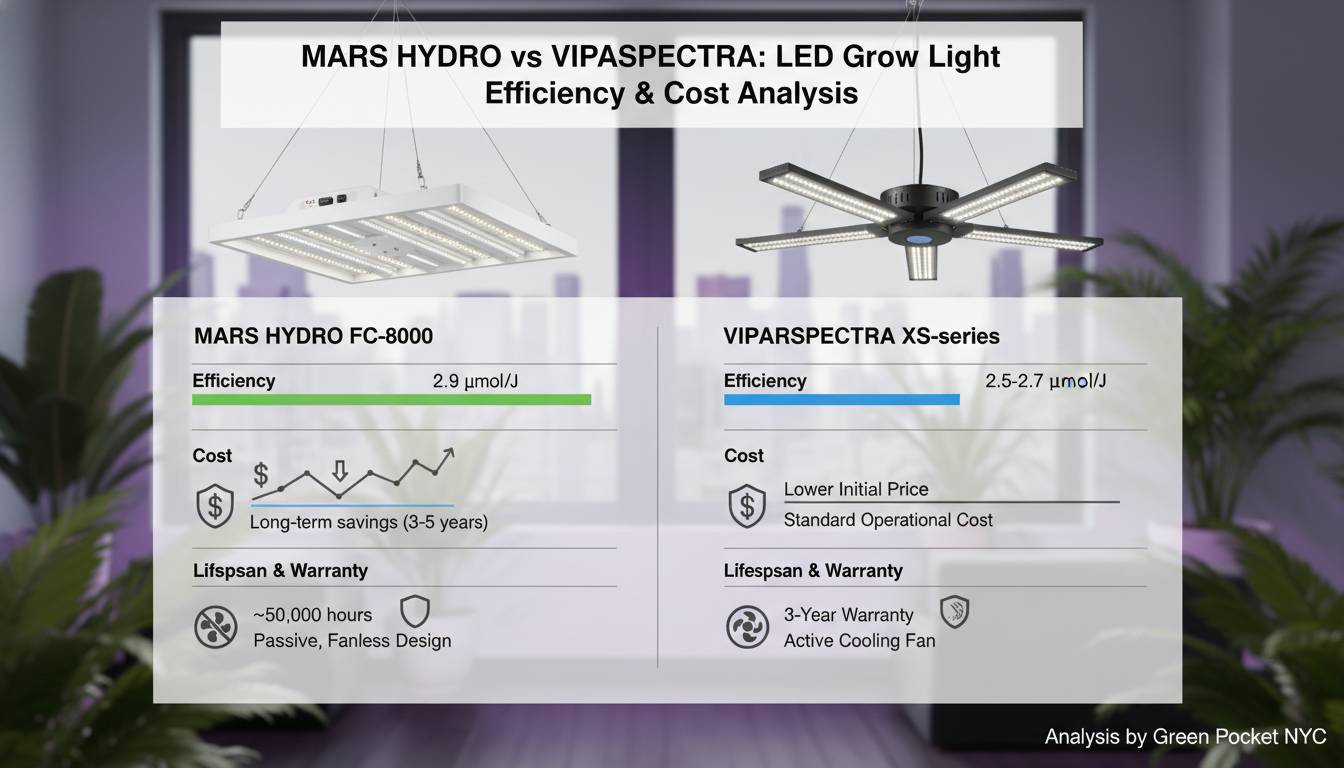
- Mars Hydro's FC1000W-EVO achieves 2.9 ?mol/J efficiency using Samsung LM301H EVO LEDs, outperforming most Viparspectra models, while some Viparspectra XS series reach up to 2.7 ?mol/J
- LED grow lights from both brands reduce energy costs by 35-50% compared to traditional HPS systems, with coverage areas directly impacting cost per square foot
- Viparspectra typically provides longer warranty periods than Mars Hydro's standard coverage, though Mars Hydro offers extended warranties on select products
- Mars Hydro claims their FC series can achieve yields up to 2.5 grams per watt, though real-world results often vary, and PPFD distribution patterns significantly affect actual plant performance
- Mars Hydro generally leads in efficiency metrics, while Viparspectra competes primarily on affordability and warranty protection
Indoor growers face a critical decision when choosing between two of the market's most popular LED brands. The choice between efficiency and affordability often determines which path delivers the best long-term value for specific growing operations.
Which LED Brand Actually Delivers More Light Per Watt
The battle between Mars Hydro and Viparspectra centers on photosynthetic photon efficacy (PPE) - the measurement of how efficiently electrical energy converts into usable plant light. This metric, expressed in micromoles per joule (?mol/J), reveals which brand actually delivers more growing power per dollar spent on electricity.
Mars Hydro demonstrates superior efficiency across their premium lines, with their FC1000W-EVO achieving 2.9 ?mol/J - among the highest ratings available from mainstream manufacturers. Viparspectra's offerings typically range between 2.0-2.7 ?mol/J, positioning them as solid performers with their higher-end XS series reaching competitive efficiency levels. Green Pocket NYC specializes in matching the right LED systems to specific growing environments, ensuring optimal light conditions for both commercial and residential indoor plant setups.
The efficiency gap translates directly into operational savings. Higher PPE ratings mean more photons reach plants while consuming less electricity - a critical factor for commercial operations running lights 12-18 hours daily. However, efficiency alone doesn't tell the complete story, as factors like light distribution, spectrum quality, and initial investment costs significantly impact overall value.
Mars Hydro FC1000W-EVO Leads With 2.9 ?mol/J Efficiency
The FC1000W-EVO represents Mars Hydro's flagship efficiency achievement, utilizing cutting-edge Samsung LM301H EVO LEDs to achieve industry-leading performance. This model delivers exceptional photon output while maintaining relatively low heat generation, reducing cooling requirements and extending component lifespan.
The 2.9 ?mol/J rating places this unit among the most efficient grow lights available from major manufacturers, significantly outperforming many competing models that struggle to exceed 2.5 ?mol/J. The FC1000W-EVO's design incorporates advanced thermal management through aluminum heat sinks and optimized LED spacing, preventing hot spots that can damage both the fixture and plants below.
Samsung LM301H EVO LEDs Set Performance Standard
Samsung's LM301H EVO diodes are among the leading horticultural LED technologies, offering superior efficiency and longevity compared to previous generations. These diodes maintain consistent output over extended periods, with minimal degradation even after 50,000+ hours of operation. The EVO series specifically targets horticultural applications, with optimized spectrum output that maximizes photosynthetic response while minimizing wasted energy in non-productive wavelengths.
The advanced chip design enables higher current densities without significant efficiency losses, allowing manufacturers like Mars Hydro to pack more photons into smaller fixtures. This translates to better coverage uniformity and reduced fixture requirements for large growing areas, ultimately lowering total system costs despite higher per-unit prices.
FC-E Series Offers Lower-Cost BridgeLux Alternative
Mars Hydro's FC-E series provides a cost-conscious alternative using BridgeLux diodes instead of premium Samsung components. While efficiency ratings remain competitive, the series maintains excellent performance characteristics at significantly reduced pricing. The BridgeLux diodes offer reliable operation and decent spectrum quality, making the FC-E series attractive for budget-minded growers who still want Mars Hydro's build quality and thermal management.
The cost savings allow growers to invest in larger coverage areas or additional equipment while maintaining professional-grade lighting performance. The FC-E series demonstrates that effective LED growing doesn't require the absolute highest efficiency ratings, particularly for smaller operations where electricity costs represent a smaller portion of total operating expenses.
Viparspectra Range: Budget P2000 to Premium XS1500 Pro
Viparspectra's product lineup spans from entry-level units targeting new growers to more sophisticated models competing with premium brands. The company's strategy focuses on delivering solid performance at competitive price points, often undercutting comparable Mars Hydro models by 15-25% while maintaining acceptable efficiency levels.
The brand's diverse range allows growers to select fixtures based on specific budget constraints and performance requirements. From the basic P2000 suitable for small tent operations to the feature-rich XS1500 Pro designed for demanding applications, Viparspectra provides options for virtually every indoor growing scenario.
P2000 System Efficiency Around 2.0 ?mol/J
The Viparspectra P2000 achieves approximately 2.0 ?mol/J efficiency, representing decent performance for its price category but falling behind Mars Hydro's premium offerings. This efficiency level remains competitive with many budget alternatives while providing better build quality and component selection than true bargain-basement options.
Despite lower peak efficiency, the P2000 provides adequate photon delivery for successful plant cultivation, particularly in smaller growing areas where absolute light intensity is less critical. The unit features full-spectrum output with integrated dimming capabilities, allowing growers to adjust light intensity throughout different growth phases without requiring additional equipment.
XS1500 Pro Uses Samsung LM301B for Higher Performance
Viparspectra's XS1500 Pro incorporates Samsung LM301B diodes - a previous-generation chip that still delivers excellent performance while maintaining cost advantages over newer EVO variants. The fixture utilizes 340 Samsung diodes supplemented by dedicated red (660nm) and infrared (730nm) chips for enhanced flowering response.
The combination approach allows the XS1500 Pro to achieve efficiency ratings closer to 2.5-2.7 ?mol/J while incorporating spectrum features specifically targeting flowering and fruiting plants. The supplemental red and far-red wavelengths can trigger beneficial plant responses that pure white LED arrays sometimes miss, potentially improving yields despite slightly lower overall efficiency numbers.
Extended Warranty vs Mars Hydro's Standard Coverage
Viparspectra typically provides longer warranty coverage compared to Mars Hydro's standard protection, though Mars Hydro offers extended warranties on certain products. The extended coverage includes a 30-day money-back guarantee and exchange policy, demonstrating the company's confidence in its manufacturing quality.
This warranty advantage partially offsets efficiency disadvantages by reducing replacement risks over the fixture's operational lifetime. For commercial operations where fixture failures can impact entire crop cycles, the extended warranty protection provides valuable insurance against unexpected equipment losses, potentially justifying slightly higher operational costs through reduced replacement frequency.
Energy Savings: LEDs Cut HPS Costs by 35-50%
Both Mars Hydro and Viparspectra LED systems deliver substantial energy savings compared to traditional high-pressure sodium (HPS) lighting, with typical reductions ranging from 35-50% in total electricity consumption. These savings compound over time, often recovering the higher initial LED investment within 12-24 months of operation.
The energy efficiency advantages extend beyond simple wattage reduction. LED systems generate significantly less heat than HPS fixtures, reducing cooling requirements and further lowering total energy consumption. In climate-controlled environments, this secondary benefit can represent an additional 20-30% reduction in total electrical usage, particularly during hot summer months when cooling costs peak.
Real Power Draw Comparison - Mars TS1000 vs Viparspectra XS1500
Direct comparisons reveal differences in actual power consumption between comparable models. The Mars Hydro TS1000 draws approximately 150 watts from the wall while covering 6.25 square feet during flowering, translating to 24 watts per square foot. The Viparspectra XS1500 consumes approximately 152 watts while effectively covering similar areas, resulting in nearly identical power density.
However, the Mars unit's higher efficiency rating means more photons reach plants per watt consumed, potentially delivering better growing results despite similar electrical usage. The efficiency advantage becomes more pronounced in larger installations where small percentage improvements multiply across dozens or hundreds of fixtures, creating substantial operational savings over time.
Coverage Areas Impact Cost Per Square Foot
Coverage specifications directly impact cost-effectiveness calculations, as fixtures providing broader useful coverage reduce the number of units required for specific growing areas. Mars Hydro's TS1000 covers 9 square feet during vegetative growth but contracts to 6.25 square feet for flowering, requiring careful planning to maintain adequate light intensity throughout growth cycles.
While Viparspectra's coverage claims often appear generous on paper, real-world PPFD measurements can reveal distribution patterns that affect effective growing area, though the brand uses lenses to promote uniform distribution. The difference between marketing coverage and usable coverage can significantly impact total system costs, particularly for growers requiring uniform light distribution across entire canopies.
Yield Claims: Mars Hydro FC Series Performance Potential
Mars Hydro claims its FC series can achieve yields up to 2.5 grams per watt, representing exceptional productivity for LED growing systems. These yield figures depend heavily on optimal growing conditions, proper environmental controls, and experienced cultivation practices - factors often overlooked in manufacturer marketing materials.
Real-world results typically fall short of maximum theoretical yields, with most growers achieving 1.5-2.0 grams per watt under good conditions. The gap between claimed and actual performance reflects the complexity of plant cultivation, where lighting represents just one factor among many affecting final harvest weights. Factors like nutrient management, environmental controls, strain selection, and growing techniques significantly influence actual yields regardless of lighting efficiency.
PPFD Distribution Affects Actual Plant Performance
Photosynthetic Photon Flux Density (PPFD) distribution patterns determine how effectively light energy converts into plant growth across the entire canopy. Even fixtures with identical average PPFD readings can produce dramatically different growing results based on light uniformity and penetration characteristics.
Mars Hydro's FC series design emphasizes even distribution through optimized LED spacing and specialized optics, reducing hot spots and ensuring adequate light reaches canopy edges. Poor distribution patterns force growers to increase overall light intensity to compensate for dim areas, effectively reducing system efficiency and increasing operating costs. Uniform PPFD distribution allows plants to utilize available light more effectively, translating efficiency advantages into actual yield improvements.
Mars Hydro Generally Leads Efficiency, Viparspectra Competes on Value
The competitive landscape reveals clear distinctions between these brands' market positioning. Mars Hydro delivers higher efficiency ratings and superior component quality, particularly in their premium FC series lineup. The company's focus on cutting-edge LED technology and advanced thermal management appeals to growers prioritizing maximum performance and long-term operational savings.
Viparspectra counters with competitive pricing, extended warranty coverage, and adequate performance for most growing applications. Their strategy targets price-conscious growers who need reliable lighting without premium pricing, providing solid value propositions for smaller operations or beginning growers building their first systems.
The choice between brands ultimately depends on individual priorities: maximum efficiency and performance versus initial cost savings and warranty protection. Commercial operations focused on optimizing long-term profitability typically favor Mars Hydro's efficiency advantages, while hobbyist growers often find Viparspectra's value proposition more appealing. Both brands deliver successful growing results when properly matched to specific applications and budgets.
For professional guidance on selecting the optimal LED system for your specific growing environment and goals, Green Pocket NYC designs and installs customized indoor plant systems that match lighting technology to actual growing conditions.